



FOOD TECHNOLOGY & AGRICULTURE · 6 MIN READ
A food product’s journey does not end when it leaves the farm. For fruits, vegetables, dairy, fish, meat and many other perishable foods, what happens after harvest can determine whether the product reaches consumers fresh, safe and usable—or becomes waste before it ever reaches the market.
This is where the cold chain becomes important. It is the network of cooling, storage, transportation and temperature management that protects food between production and consumption. While consumers may only see the final product, an effective cold chain works quietly in the background, preserving its quality throughout the journey.
Food begins changing the moment it is harvested
Harvesting marks the beginning of a new stage in a food product’s life. Fruits and vegetables continue to respire after they are picked, while milk, fish, meat and other perishables remain highly sensitive to temperature.
If these products are exposed to unsuitable conditions for extended periods, their quality can deteriorate quickly. In many cases, refrigeration is therefore not simply about making food cold. It is about slowing biological and chemical processes that reduce freshness and shelf life.
This makes temperature control an important part of the food system long before a product reaches a supermarket or household refrigerator.
Cooling begins before storage
Fresh produce often carries significant field heat immediately after harvest. Removing that heat quickly through pre-cooling can help slow deterioration before the product enters storage or transportation.
This is particularly important for products that travel long distances between agricultural regions and consumption centres. A cold room cannot completely compensate for poor temperature management during the earlier stages of the journey.
The strongest cold chains therefore begin as close to the farm as practical. Harvesting, sorting, grading, packing and pre-cooling can become connected processes rather than isolated activities.
Refrigeration works only when the links work together
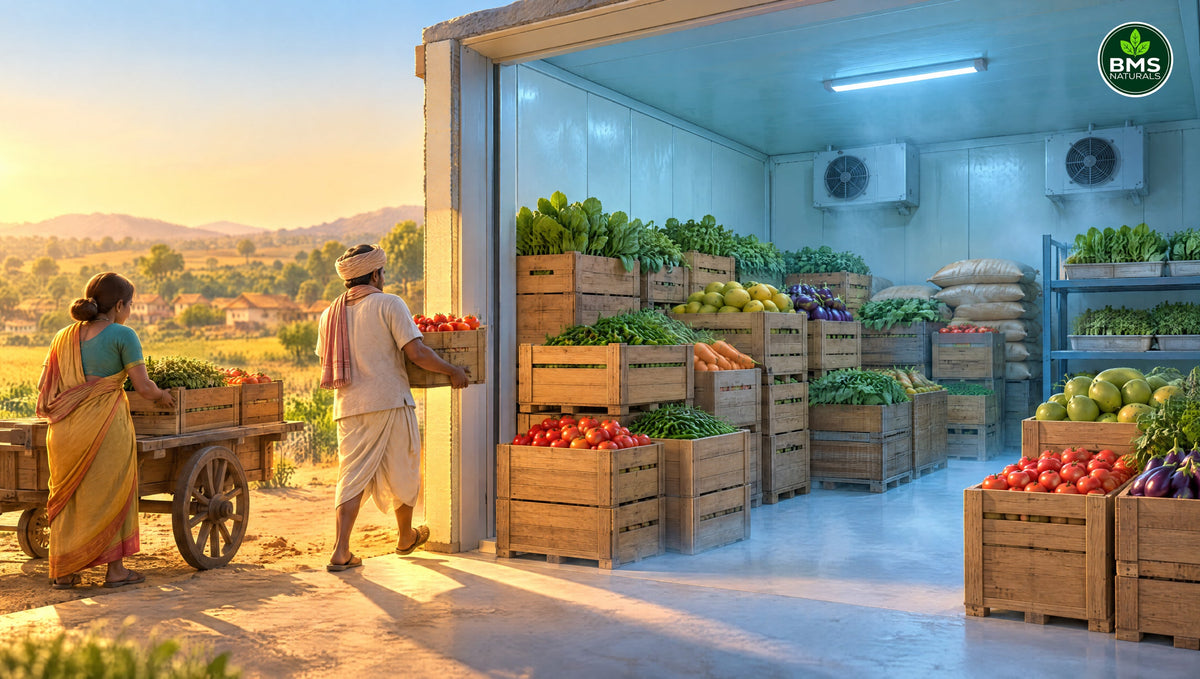
A cold chain is not simply a warehouse filled with refrigerators. It is a sequence of connected operations that may include farm-level cooling, cold storage, refrigerated transportation, processing, distribution and retail.
Each stage has a specific role. Pre-cooling removes field heat. Cold storage maintains appropriate conditions. Refrigerated vehicles protect products while they are transported. Processing facilities may chill, freeze or otherwise preserve products depending on their characteristics.
The objective is continuity.
If food is maintained at the correct temperature in storage but exposed to unsuitable conditions during transportation, the integrity of the chain can be compromised.
Building infrastructure around perishables
India has been expanding its cold-chain infrastructure as part of efforts to strengthen post-harvest management and food processing.
Government-supported integrated cold-chain projects cover activities ranging from farm-level handling and pre-cooling to cold storage, processing and refrigerated transportation. The objective is to create a more connected journey from the farm gate to the consumer rather than treating storage as an isolated requirement.
This is particularly relevant for a country with diverse agricultural production and large distances between production centres and major consumer markets.
The challenge is not simply to create more cold-storage capacity. It is to create the right infrastructure in the right locations and connect it effectively to farmers, processors and markets.
Time can become an agricultural resource
For farmers dealing with perishable products, timing can be critical.
When there is no suitable storage or cooling infrastructure nearby, harvested produce may need to be sold quickly. That can leave little flexibility between harvest and market.
Appropriate cold-chain infrastructure can create additional time.
Time to aggregate produce.
Time to grade and sort it.
Time to arrange transportation.
Time to connect with an appropriate buyer.
Time to process the product.
In this sense, refrigeration is not simply preserving food. It can help preserve commercial options within the agricultural value chain.
Connecting farmers with infrastructure
Cold-chain infrastructure can become more useful when it is connected to organised farmer networks.
Farmer Producer Organizations can aggregate produce from multiple farmers, making it easier to coordinate collection, transportation, storage and market access. Instead of each farmer trying to manage the post-harvest journey independently, collective systems can create greater scale.
For perishable products, this can be particularly valuable because aggregation and temperature management often need to happen quickly.
The FPO can therefore become an important bridge between the farm and the infrastructure required to move agricultural products safely and efficiently toward the market.
Cold-chain science is about precision
One of the biggest misconceptions about refrigeration is that all food simply needs to be kept as cold as possible.
In reality, different products require different conditions.
Fresh fruits and vegetables may require carefully controlled temperature and humidity. Dairy products require appropriate chilling. Fish and meat may require chilled or frozen environments depending on the product and stage of processing. Frozen foods require continuous low-temperature conditions throughout transportation and storage.
Modern cold-chain management therefore involves much more than refrigeration. It can include pre-cooling, controlled-atmosphere storage, freezing, blast freezing, temperature monitoring and specialised transportation.
The goal is not maximum cold.
The goal is the right condition for the right product.
From refrigeration to real-time monitoring
The modern cold chain is becoming increasingly data-driven.
Temperature sensors can continuously monitor storage and transportation conditions. Digital systems can record temperature fluctuations and create alerts when conditions move outside defined limits. Tracking technologies can provide visibility into where a shipment is and how it has been handled.
This creates a shift from simply storing food in a cold environment to actively managing the conditions around it.
For food businesses, such monitoring can provide valuable information about where quality problems occur. For consumers, it can eventually contribute to greater transparency around how perishable products reach the market.
Keeping food cold also requires responsible cooling
Cold-chain expansion comes with another challenge: energy consumption.
Refrigeration systems require reliable power, and large-scale cold storage can consume significant amounts of energy. As India's temperature-controlled infrastructure expands, efficiency will therefore become increasingly important.
Better insulation, efficient refrigeration equipment, thermal storage and renewable-energy solutions can help reduce the energy burden associated with cooling.
For rural and remote areas, decentralised cold-storage systems powered partly by renewable energy could also create new possibilities for post-harvest management.
The future of cold chains will therefore be about two things at once: preserving more food and using energy more intelligently.
What is wasted after harvest has already consumed resources
Food loss is not only the loss of the final product.
When food is wasted, the land, water, labour, energy and agricultural inputs used to produce that food have also been used without delivering their intended value.
This makes post-harvest preservation part of the larger sustainability conversation.
Reducing food loss does not necessarily require producing more food. In some cases, it means protecting more effectively what has already been produced.
A better cold chain can therefore contribute to a more efficient food system by helping a larger share of agricultural production reach consumers in usable condition.
The future is about connection
The most useful cold-chain infrastructure is not necessarily the largest facility.
Its value comes from how well it connects different parts of the food system.
A farmer needs access to collection.
The collection point needs appropriate handling.
The product needs timely cooling.
The cold store needs reliable energy.
The transporter needs temperature control.
The processor needs consistent raw material.
The market needs dependable supply.
When these elements work together, refrigeration becomes more than a storage technology. It becomes infrastructure connecting farmers, food businesses and consumers.
Protecting the journey from farm to fork
The Farm-to-Fork approach is ultimately about understanding the complete journey of food—from where it is grown to where it is consumed.
For perishable agricultural products, that journey includes much more than sourcing. It also includes handling, storage, transportation, processing and quality preservation.
A stronger cold chain can help protect the value created at the farm level by ensuring that products do not lose their quality simply because the post-harvest system is unable to maintain appropriate conditions.
For organisations working with farmer collectives, this connection becomes particularly important. Better post-harvest infrastructure can help bridge the gap between agricultural production and consumer markets while supporting a more organised and traceable food journey.
We often think food waste begins when someone throws food away. In reality, some food may already be on its way to becoming waste long before it reaches the kitchen.
A delayed truck, inadequate cooling, poor storage or a broken temperature chain can gradually reduce the value of food without consumers ever seeing what happened.
That is why cold-chain infrastructure matters.
It operates largely out of sight, but its impact can be visible on farms, in markets and eventually on household plates.
From preserving food to protecting its value
India's cold-chain challenge is not simply a refrigeration challenge. It is a coordination challenge across agriculture, infrastructure, technology, logistics and food processing.
The next generation of cold chains will need to move closer to farms, become more energy-efficient, use real-time monitoring and connect more effectively with FPOs and organised markets.
The objective is not merely to keep food cold.
It is to protect the work that has already gone into producing it.
Because the journey from farm to fork does not end at harvest. Sometimes, the difference between food that reaches the table and food that becomes waste is the temperature maintained along the way.

Your cart is currently empty.
A farmer's harvest isn't. Not sure where to start?
Browse our collections


