


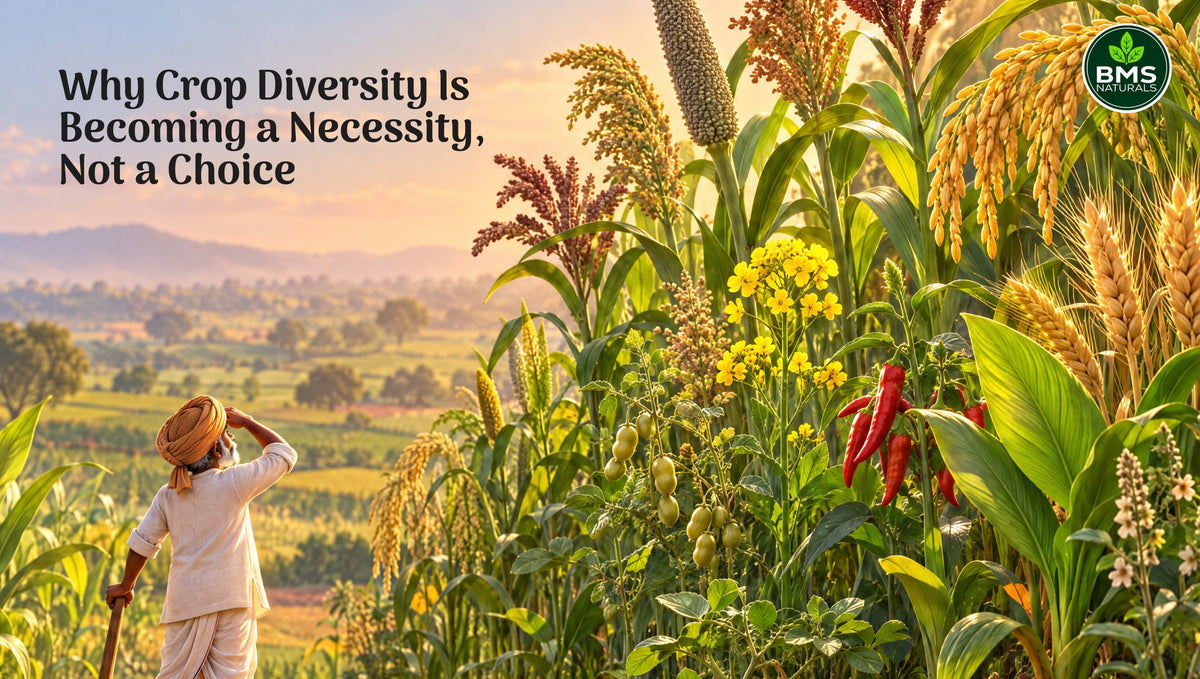
For decades, Indian agriculture has focused strongly on increasing productivity and meeting the food requirements of a growing population. That approach played a crucial role in strengthening food availability. But agriculture today is facing a different challenge. Climate change, changing consumer needs, water stress, soil degradation and global supply-chain disruptions are making it increasingly important to build a food system that is not only productive, but also diverse and resilient.
This is why crop diversity is becoming one of the most important conversations in the future of food security.
A food system that depends heavily on a limited number of crops can become vulnerable when climate or market conditions change. If drought affects one crop, a disease damages another, or international prices rise sharply, communities that depend on a narrow agricultural base can face greater uncertainty. A more diverse system, on the other hand, distributes risk across different crops and growing conditions.
India already has a rich agricultural heritage that offers valuable lessons. Millets, pulses, oilseeds, traditional grains, spices and region-specific crops have been cultivated across the country for generations. These crops form an important part of India's food culture while contributing to dietary diversity and agricultural biodiversity. The renewed interest in millets and traditional foods is therefore not simply about bringing old foods back into modern kitchens; it is also about recognising the importance of diversity in a changing agricultural environment.
Pulses are a particularly important example. Dal, chickpeas, lentils, peas and other legumes are important sources of plant protein and other nutrients, while legumes can also contribute to healthier cropping systems through their relationship with soil nitrogen. Increasing the diversity of pulses in Indian agriculture can therefore support both nutrition and agricultural sustainability.
Millets offer another important example. Crops such as ragi, jowar and bajra have traditionally been cultivated in different parts of India and are valued for their nutritional characteristics and adaptability to varied growing conditions. Their growing presence in modern diets shows how traditional agricultural knowledge can find relevance in contemporary food systems.
However, crop diversity cannot survive through farming alone. There must also be consumer demand. Farmers ultimately respond to markets, and when consumers consistently purchase a wider range of grains, pulses, seeds and traditional foods, they create economic opportunities for diversified agricultural production.
This is where the connection between farmers, businesses and consumers becomes important. A Farm-to-Fork approach can help create stronger links between agricultural communities and the people who consume their produce. For BMS Naturals, working with Farmer Producer Organizations and focusing on traditional grains, pulses, seeds, spices and minimally processed foods provides an opportunity to support this wider agricultural ecosystem.
Technology can further strengthen this transition. Better agricultural data, weather forecasting, digital traceability and improved quality testing can help farmers and businesses manage increasingly complex supply chains. At the same time, traditional knowledge remains valuable because farmers understand local soil, seasons and crops in ways that technology alone cannot replicate.
Crop diversity is also closely connected to nutrition. A resilient food system should not focus only on producing calories; it should provide access to a wider range of nutrients. Diversifying what is cultivated can therefore contribute to diversifying what reaches our plates.
The future of Indian agriculture will require a balance between productivity and resilience. Modern agricultural technologies, improved varieties and scientific research will remain essential, but they need to work alongside biodiversity, traditional crops, healthy soils and efficient resource management.
The answer to future food challenges may therefore not be found in producing more of fewer crops, but in growing a smarter and more diverse range of foods.
For farmers, diversity can mean greater resilience. For consumers, it can mean greater nutritional choice. For businesses, it can mean stronger and more responsible agricultural value chains. And for India, it can contribute to a food system better prepared for an uncertain future.
The future of food may not belong to one crop or one technology. It may belong to diversity itself.


