


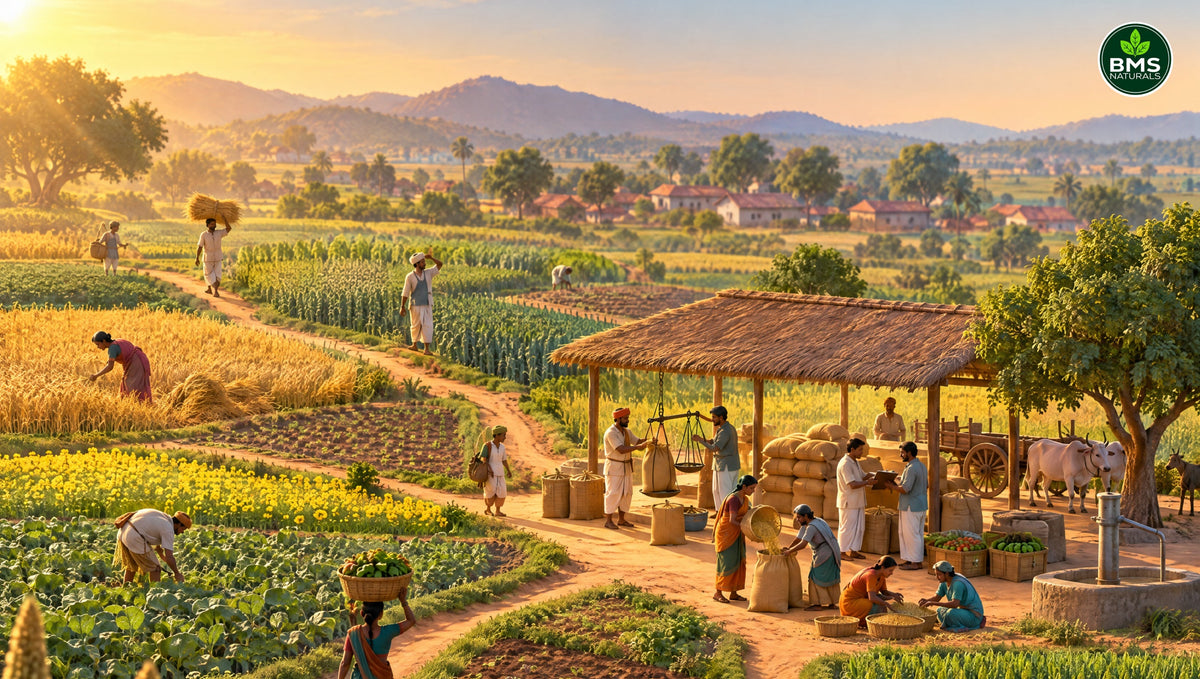
Roughly 85 percent of India's farmers cultivate less than two hectares of land. Individually, a farmer with a small, fragmented holding has almost no ability to negotiate fertiliser prices, no easy way to reach a distant market at a fair rate, and little chance of qualifying for institutional credit without collateral. Multiply that farmer by the tens of millions of agricultural households scattered across India's villages, and the scale of the problem becomes clear: individually weak, but collectively, the same farmers represent enormous bargaining power, production volume and market potential. Farmer Producer Organizations, or FPOs, exist to convert that collective potential into collective strength.
An FPO is, at its core, a registered business owned and controlled by farmers themselves — usually structured as a producer company under the Companies Act, though cooperative and other legal forms exist too. Members pool their produce, their purchasing needs and their voice, and the organisation acts on their behalf: buying seeds and fertiliser in bulk at lower rates, aggregating harvests to negotiate better prices, arranging storage and transport, and increasingly, building direct relationships with processors, retailers and consumer brands. It draws on much older traditions of farmer cooperation, but its formal, business-oriented version is a comparatively recent addition to Indian agricultural policy.
The push to scale FPOs nationally began in earnest around 2011, when the government designated the Small Farmers' Agribusiness Consortium as the nodal agency to promote them, initially through schemes tied to vegetable and pulse cultivation. NABARD joined soon after as a second major promoter, backing FPOs with credit lines and capacity-building support. The real inflection point, though, came in February 2020, with the launch of the Central Sector Scheme for Formation and Promotion of 10,000 FPOs, backed by a budget of Rs 6,865 crore running through 2027-28. Under the scheme, each new FPO can receive up to Rs 18 lakh in management-cost support over three years, a matching equity grant of up to Rs 15 lakh, and a collateral-free credit guarantee of up to Rs 2 crore against project loans, with government-appointed agencies deploying Cluster-Based Business Organisations to provide hands-on professional handholding for five years after formation.
The scheme crossed its headline target in early 2026. Government data put the total number of farmers mobilised under it at more than 56 lakh as of 1 January 2026, of whom close to 22 lakh — nearly two in five — are women, including 1,175 FPOs run entirely by women members. The 10,000th FPO to be registered, focused on maize, banana and paddy cultivation in Khagaria district, Bihar, was launched by the Prime Minister at a PM-KISAN instalment event. To date, equity grants worth over Rs 254 crore have reached close to 4,800 FPOs, and credit guarantee cover worth over Rs 450 crore has been extended to nearly 1,900 of them.
Reaching the numerical target, however, is not the same as building durable institutions, and policymakers have been candid about this. In December 2025, the Agriculture Secretary indicated the scheme would be extended for a further five years, from 2026 to 2031, precisely because many FPOs formed in the last two years still need sustained handholding rather than one-time support. The gap is well documented: studies of FPO performance repeatedly point to thin working capital — the average FPO's paid-up capital commonly sits between roughly Rs 1 lakh and Rs 3 lakh — combined with a lack of collateral, which makes banks reluctant to lend regardless of the credit guarantee available on paper. Governance is another recurring weak point, since farmer-directors are rarely trained in company management, accounting or negotiation, and disputes over leadership can quietly erode member participation over time. And even FPOs that succeed at aggregating produce often stall at the next step: building the kind of consistent, branded market relationships that convert a harvest into stable income rather than a one-time sale at the local mandi.
This is precisely the gap where partnerships with market-facing businesses matter as much as government support. An FPO can organise a village's farmers, negotiate fair prices for their inputs, and pool their harvest — but turning that pooled harvest into a trusted, branded product on a shop shelf or a website usually requires quality assurance systems, packaging, certification, logistics and consumer-facing marketing that most FPOs, run by farmers rather than food-industry professionals, are not built to provide on their own. That is the specific role a company like BMS Naturals occupies within the FPO ecosystem — not as a replacement for the FPO model, but as the missing link between it and the end consumer.
BMS Naturals currently works with over 1.5 lakh farm families through more than 50 Farmer Producer Organisations, concentrated across districts such as Sitapur, Hardoi and Bareilly in Uttar Pradesh — among them the Hargaon Farmer Producer Company, Sandeela Annadata Farmer Producer Company, Biswan Annadata Agro Producer Company, Ailiya Annadata Producer Company, and the Behadar and Bharawan Farmer Producer Companies. According to the company, this network has contributed to an annual farmer uplift of more than Rs 6.5 crore, built on a model of 100 percent direct sourcing — buying traditional grains, pulses, oilseeds, honey and herbs straight from these FPOs rather than through layers of intermediaries. In practical terms, this is the private-sector half of the FPO equation: the FPOs handle aggregation, farm-level quality control and price negotiation on behalf of their member-farmers, while BMS Naturals takes on fair procurement, further quality assurance, branding and the market access needed to move Sitapur wheat or Hardoi honey into kitchens across the country.
Whether India's now more-than-10,000 FPOs go on to become durable engines of rural income, or fade into the long list of well-intentioned schemes that struggled with working capital and weak market linkages, will likely depend on exactly this combination — continued institutional handholding from CBBOs, NABARD and the government scheme on one side, and consistent, demand-generating partnerships with processors, retailers and consumer brands on the other. Collective farming has already given millions of small and marginal farmers a stronger negotiating position than they had a decade ago. What it needs next, at scale, is a reliable bridge to the market — and that bridge is being built one FPO, one district, and one farm-to-fork relationship at a time.


