


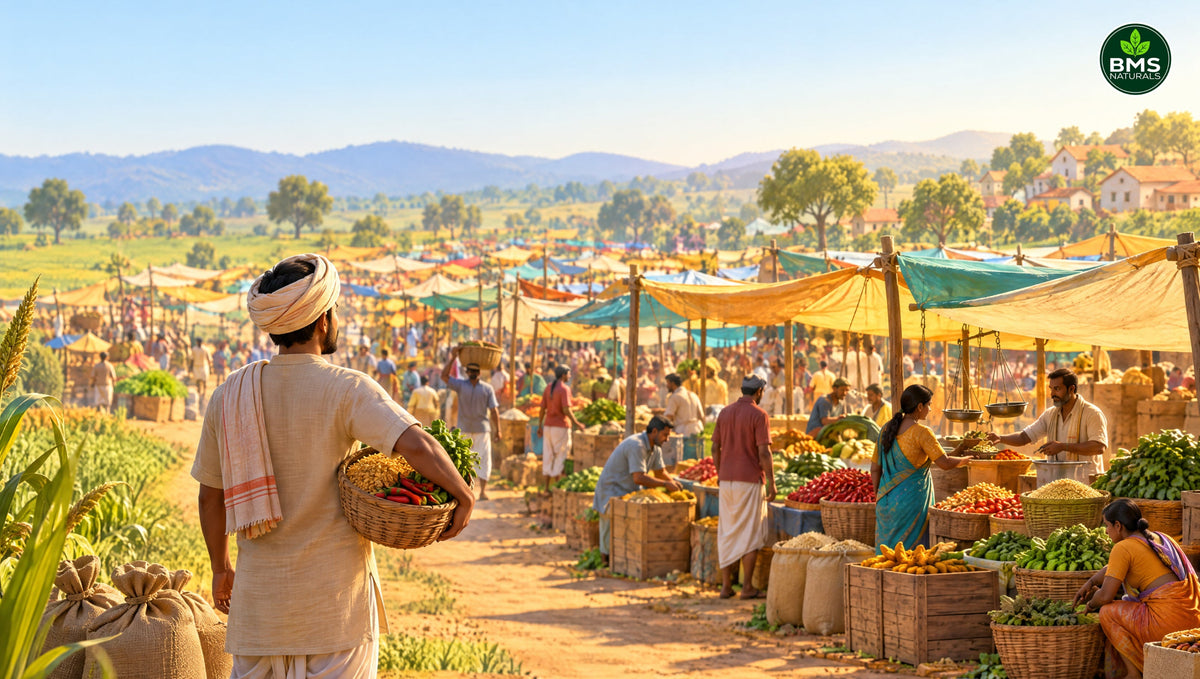
For a small farmer, producing a good crop is only the beginning. The bigger challenge often starts after harvesting: finding the right buyer, getting a fair price, arranging transportation, accessing quality inputs, investing in storage or processing, and competing in markets that increasingly demand consistency and scale. For decades, fragmentation has been one of the structural challenges of Indian agriculture. Millions of farmers produce relatively small quantities individually, while buyers and markets often operate at much larger scales. Farmer Producer Organizations, or FPOs, are emerging as an important bridge between these two worlds.
An FPO brings farmers together as a collective business organization. Instead of each farmer negotiating, purchasing inputs or approaching markets independently, members can aggregate their produce, access inputs collectively, undertake processing and approach larger buyers with greater scale. The concept is simple, but its potential impact on agricultural value chains is significant: collective strength can give small farmers access to opportunities that may be difficult to reach individually.
The scale at which this movement is developing is substantial. Under the Government of India's Central Sector Scheme for Formation and Promotion of 10,000 FPOs, 10,000 FPOs had been formed by August 2026. These organizations are engaged in activities ranging from input supply and aggregation to trading, processing, seed production, digital commerce, custom hiring and export promotion. As of July 2026, the FPOs established under the scheme had reported a cumulative turnover of approximately ₹20,358 crore. (Press Information Bureau)
The significance of FPOs becomes clearer when we look at the economics of scale. A small farmer selling a limited quantity of produce may have little negotiating power with a large buyer. But when hundreds of farmers collectively aggregate their produce, the volume becomes commercially meaningful. The FPO can potentially negotiate better terms, standardise quality, coordinate transportation and connect directly with institutional buyers. The farmer remains an individual producer, but becomes part of a larger market-facing organization.
This collective approach can also change the way farmers access agricultural inputs. Instead of purchasing seeds, fertilisers or other inputs individually, an FPO can aggregate demand and potentially negotiate more efficiently. Similarly, shared equipment and custom hiring services can make certain technologies and machinery more accessible to farmers who may not find individual ownership economically viable.
Perhaps the most important transformation, however, is the movement from selling produce to participating in the value chain. Traditionally, a farmer may sell raw produce immediately after harvest, often because of limited storage or immediate financial requirements. An FPO with appropriate infrastructure can potentially aggregate, grade, sort, store or process produce before taking it to market. This creates opportunities for farmers to participate further along the value chain rather than remaining limited to primary production.
Government data shows that this transition is already taking place. By August 2026, 5,765 FPOs under the central scheme had their own processing units, while 3,083 had availed credit guarantees. The reported turnover data also shows that FPOs are at different stages of business development, with some still building their operations and others crossing ₹1 crore in annual turnover. (Press Information Bureau)
Digital agriculture is adding another dimension to this transformation. India's e-NAM platform had integrated 1,656 mandis across 23 States and 4 Union Territories by March 2026, with more than 1.80 crore farmers and 4,724 FPOs registered. Cumulative trade through the platform had reached approximately ₹4.84 lakh crore. Digital marketplaces can help improve price discovery and provide FPOs with additional channels through which aggregated produce can reach buyers. (Press Information Bureau)
FPOs are also becoming an important platform for women's participation in agriculture. Of the 10,000 FPOs formed under the central scheme, 1,175 have 100% women membership, while approximately 23.55 lakh women farmers were registered under the initiative as of March 2026. This demonstrates how collective institutions can also become mechanisms for strengthening women's participation in agricultural enterprises and rural economies. (Press Information Bureau)
Yet an FPO is much more than a group of farmers. For an FPO to become commercially sustainable, it needs effective management, financial discipline, market intelligence, quality systems, infrastructure and reliable business relationships. The government's scheme therefore provides professional handholding for five years, along with management support, equity grants, credit guarantees, training and market-linkage assistance. (Press Information Bureau)
This is where businesses within the agricultural value chain have an important role to play. FPOs need dependable markets just as markets need reliable sources of agricultural produce. When businesses establish long-term relationships with farmer organizations, they can create more structured demand while FPOs can work towards supplying consistent quantities and quality.
For BMS Naturals, this connection is particularly relevant. Its Farm-to-Fork approach creates a link between farming communities and consumers, while its work with Farmer Producer Organizations provides a pathway for agricultural produce to move into organised markets. The focus on traditional grains, pulses, seeds, spices and minimally processed foods also creates an opportunity to bring greater visibility and market value to diverse agricultural products.
This relationship can create value on both sides. Farmers gain access to organised demand and potentially broader markets, while businesses gain a more structured connection with agricultural producers. Consumers, in turn, become part of a more visible supply chain where the journey of food can be connected more closely to its agricultural origin.
The larger significance of FPOs lies in this shift in perspective. Small farmers do not necessarily need to become large farmers to participate in larger markets. They can become stronger market participants by working collectively.
That is the fundamental promise of the FPO model: aggregation without losing farmer ownership, scale without eliminating local participation, and market access without disconnecting agriculture from its communities.
India's agricultural future will require more than higher production. It will require stronger farmer institutions, better market linkages, improved infrastructure and greater participation of farmers in the value created from their produce.
FPOs can be an important part of that transformation.
Because when small farmers come together, their individual scale may remain small—but their collective market power can become much larger.


