


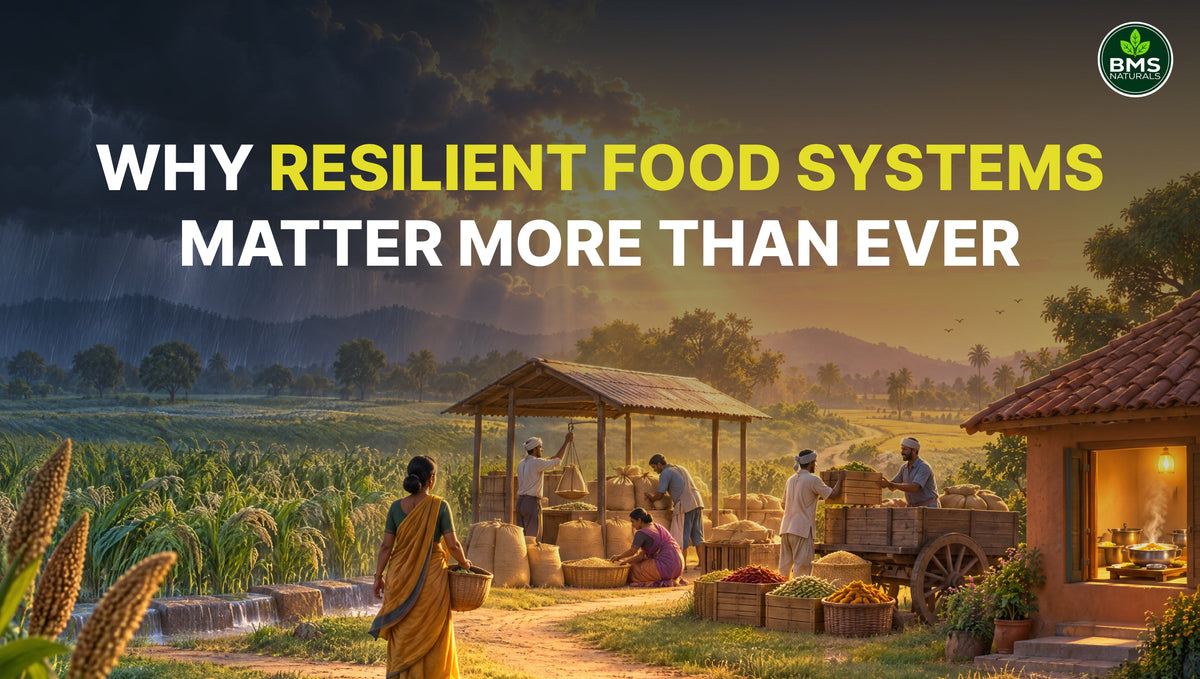
Food security is no longer simply about producing enough food. In a world facing climate change, geopolitical tensions, economic uncertainty and supply-chain disruptions, it is increasingly about ensuring that people have continuous access to safe, nutritious and affordable food. Recent developments in global food markets have highlighted this vulnerability. In August 2026, the FAO Food Price Index reached 133.3 points, its highest level since November 2022, while the global cereal production forecast for 2026 was revised to around 2.98 billion tonnes, approximately 2% lower than the previous year. At the same time, an estimated 2.1 billion people experienced moderate or severe food insecurity in 2025, showing that food availability and food access remain major global challenges.
For India, these developments carry particular significance. Agriculture is closely connected to rural livelihoods, national food security and the wider economy. Nearly 60% of India's net sown area is rainfed, making millions of farming households dependent on increasingly unpredictable weather conditions. Droughts, floods, heatwaves and irregular rainfall can affect production, while global disruptions can influence the cost and availability of agricultural inputs and commodities. This means that strengthening India's food security requires more than maintaining food stocks; it requires building an agricultural system capable of responding to changing conditions.
India has developed important mechanisms to provide a buffer against such disruptions. As of May 2026, the country's central pool held approximately 513 lakh metric tonnes of wheat and 397 lakh metric tonnes of rice, significantly above prescribed buffer norms. The National Food Security Act also provides subsidised foodgrains to approximately 81.35 crore beneficiaries. These systems play an important role in protecting food availability during periods of uncertainty, but long-term food security ultimately depends on the strength of the entire agricultural ecosystem.
At the centre of that ecosystem are farmers. Their ability to continue producing food depends on access to quality seeds, water, technology, agricultural knowledge, finance and reliable markets. Climate-resilient varieties, efficient irrigation, healthier soils and diversified cropping systems can help reduce vulnerability to environmental shocks. Diversification is particularly important because a food system that depends heavily on a limited number of crops can become more exposed to climate and market disruptions. Traditional grains, millets, pulses and oilseeds can contribute to greater agricultural diversity while also providing important nutritional value.
Food security also extends beyond the farm. Food can be lost or damaged during harvesting, storage, transportation and processing, meaning that increasing production alone cannot solve the problem. Better infrastructure, efficient supply chains, improved storage and digital monitoring can help ensure that more of what farmers produce ultimately reaches consumers. Technology can further strengthen these systems through digital traceability, supply-chain management, weather intelligence and data-driven agricultural planning.
This broader understanding of food security is closely connected to the Farm-to-Fork approach of BMS Naturals. By working with Farmer Producer Organizations and agricultural communities, BMS Naturals can contribute to stronger connections between farmers and markets while creating greater awareness around traditional grains, pulses, seeds, spices and minimally processed foods. Supporting a wider range of agricultural products can encourage greater crop diversity and create stronger demand for products originating from farming communities.
Consumers are also an important part of this ecosystem. Choosing diverse and nutritious foods, supporting seasonal products and reducing food waste can contribute to a more sustainable and resilient food system. Every food item that reaches the consumer represents land, water, energy, labour and resources invested throughout the agricultural chain. Using these resources responsibly is therefore an essential part of long-term food security.
Global crises have shown that food systems cannot be viewed in isolation. A conflict thousands of kilometres away, an extreme weather event in a major producing region or a disruption in international trade can eventually influence prices and availability in other markets. The answer is not to disconnect from the global food system, but to build sufficient domestic resilience, agricultural diversity and supply-chain strength to withstand external shocks.
For India, the future of food security will depend on the combined strength of farmers, agricultural institutions, technology, businesses and consumers. Building resilient farms, supporting diverse crops, strengthening farmer-market linkages and reducing losses across the supply chain can make the food system better prepared for an uncertain future.
Food security is no longer simply about having enough food today. It is about building a resilient food system capable of feeding people tomorrow, regardless of the challenges the world may face.


